Anne Mirtschin is a secondary teacher who teaches Information Technology and Accounting. You can check out her personal website here! In this webinar, she describes using the program Skype to create a global classroom. As I listened to her talk, I found myself getting excited by the possibilities. Honestly, I am surprised this thought never occurred me before. Teachers are expanding their personal networks beyond continents. I can connect with a fellow teacher from the FUTURE....if they are in certain time zones! And more importantly, children can interact with their peers all the way across the world. I thought about these things as I watched slides tick by and felt like a small child who finds out they are going to Disney World!
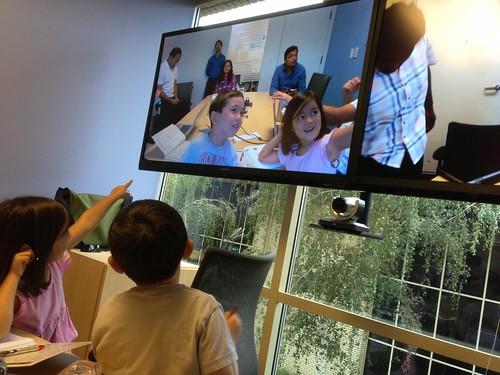
The students in Anne Mirtschin's classroom used Skype calls to connect with classrooms across the globe, partly through the efforts of the Hello Little World Skypers. They would connect multiple times, creating relationships and answering each others' questions. It is not a foreign concept at all. People have been making video calls in business to connect with corporations on the other side of the world for years. Why not utilize that same technology in classrooms?
I am working to become a middle school Social Studies teacher. The idea of being able to talk to another teacher in say, Greece or Italy while teaching about the Ancient Romans or Ancient Greeks thrills me. To have a group of children on the other side of the world share their lives with my students by just clicking a little green telephone icon is amazing. With organizations like Hello Little World Skypers, I can create a whole different way of evaluating what they are learning and do assessments that span continents, all the while, engaging the students on a global scale with the use of digital media and technology!
 |
| Source |
In the webinar, Anne mentions how using Skype and global education can help expand my personal network across the world. That would allow me to learn about new research and keep up-to-date on professional literature to an even greater scale. A new educational tool emerges in Japan? Well, my PLN contact in Hiroshima has more information on it. The opportunities are endless!
 |
| Source |
I watched many MANY more webinars on this topic after this one because I found them fascinating. As a whole, I think the webinars are a great learning tool as an educator. I happened to love Anne Mirtshin's presentation, even if occasionally I had trouble understanding her, but, I could also easily see webinars being very dry and difficult to get through at times. I watched a recorded webinar, but I think it would have been more engaging had I been there for it "live." I then could have talked with the other educators taking part, and maybe even make more connections for my PLN.
For me as a Social Studies teacher, a global classroom means opening up doors for students. It means experiencing cultures other than their own. It means seeing a world outside their own town or country. Social Studies is about our past and our present and how they intertwine, and to truly know how things have changed, most people need to see it. And through a global classroom, the students, and even the educators, can experience it.

I agree, Skype is a wonderful and useful technology. I believe it has the capability to cut costs at colleges and universities if they would just make more use of it. So many college professors still go to their annual conventions and present, many still at the cost of students. Why is it students and their parents still need to fund this? I thought this was the point aspect of webinars and Skype. I guess I must have missed something!
ReplyDelete